The Enigma That Is Egypt
Timeline: Checked into Port Ghalib on 21th. April; 10th. May Suez canal transit began: Port Suez to Ismailia; 29th. May Suez canal transit: Ismailia to Port Said; Departed Port Said on 29th. May 2006.
Click here for a map of the journey.
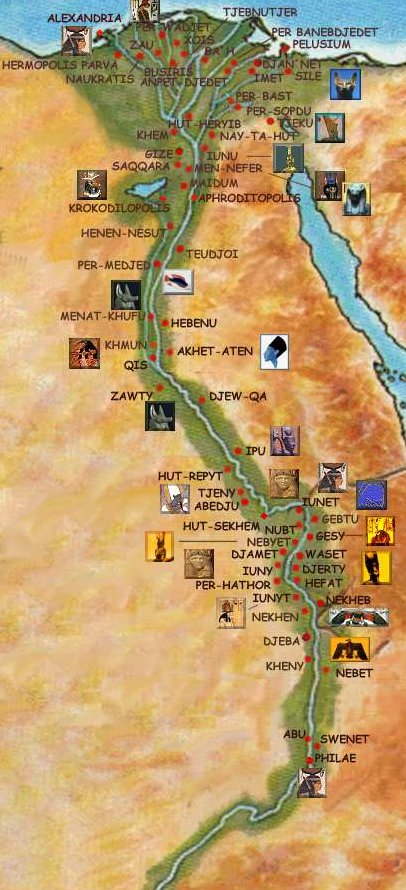
Click here for a map of Egyptian Temples.
Five weeks in Egypt was certainly not enough time to explore what remains of all the wonders of the ancient civilisations that flourished here over the ages, nor to fully experience modern life with its hustle and bustle of shopping opportunities. But, at the same time, it was as much as we felt we could take! So our travels are but an incomplete snapshot of a vast land, full of contrasts, whose long history of pharaohs and complex array of gods and goddesses was fascinating yet hard to absorb.
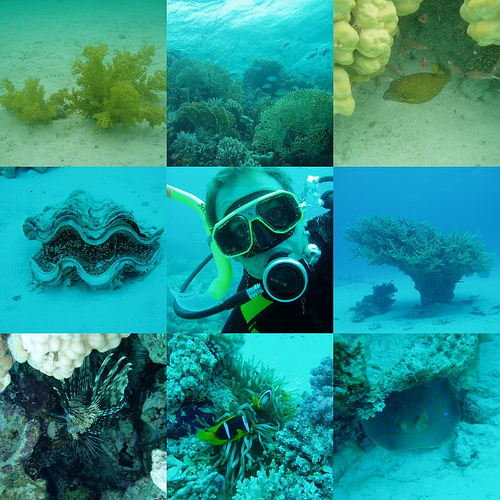
Our first introduction to Egypt came before our official check-in at Port Ghalib. Due to inclement weather we went into Marsa Halaib where we were greeted variously by grey dolphins, the Egyptian Army (who welcomed us to Egypt over the VHF) and fellow cruisers, who were also sheltering in this anchorage. By way of a different introduction I developed what was later diagnosed by a (very pleasant) doctor at Port Ghalib as amoebic dysentery, one of Egypt's many mysteries, as no-one else on board succumbed. The weather was the dominant factor in deciding when and where to move as we headed north, otherwise sailing in Egyptian waters proved unmemorable. Fish were no longer abundant and the waters not so appealing for snorkelling. We had a 5-day stop for inclement weather at Sharm Luli, a peaceful anchorage but with nothing more than some locals who were willing to supply fruit and vegetables at a high price. Port Ghalib and Abu Tig Marinas had pretty good facilities but were strangely manufactured, modern, boring, communities set on the edge of desert, however, our stay there meant we could catch up with other cruisers that we had not seen for a while. Endeavour Harbour on Tawila Island provided a safe anchorage for 4 windy days, but a walk onshore to the west side of the island revealed tar deposits, plastic rubbish and swarms of jellyfish. Yuk!
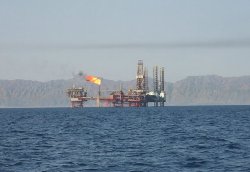
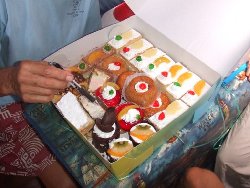
Saturday May 6 dawned flat calm: time to go north again. 32 hours of motor-sailing later we were tied to mooring buoys in Port Suez, glad to be past the oil slicks, oil wells, platforms, and big shipping. Facilities here were disappointing, though a cheery boatman came round each day offering fresh fruit, vegetables and eggs for whatever price you wanted to pay! We had the pleasure of meeting our agent, "The Prince of the Red Sea", with his giant gift-box of cakes, and also his son Captain Heebi.
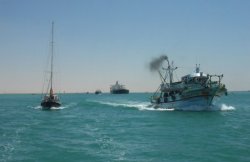
During our stay we watched the huge container ships going through the Suez Canal, as well as the substantial number of warships. 3 days later our turn came, and by 7p.m. Wednesday 10th May we were tied up bows-to at Ismailia Yacht Club, half-way up the Suez canal. Our stay here was a very pleasant interlude: showers, washing machine and a cafe producing excellent pizza readily to hand. The town supplied all our needs with its internet cafes, supermarket, bakery, post office, fruit and vegetable stalls, all within walking distance. The people were friendly and seemed pleased to see foreigners, and Egyptian women were at last in evidence and not all heavily veiled. With armed guards at the Security Gate to the Yacht Club this was a good place to leave "Avalon" whilst we travelled inland.
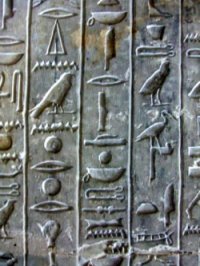
It took us some time to decide how and where to travel within Egypt: we used a tour company, having a van and guide to ourselves for most days, but travelling by night sleeper train from Cairo to Aswan, sailing by felucca down the Nile from Aswan, and night sleeper back to Cairo. It all worked out very well. We also managed to fit in a dawn hot air balloon trip whilst staying in Luxor. Aside from being a good time of day with regard to temperature, we had fantastic views over the escarpment on the west bank of the Nile with its cliff tombs, the massive Temples of Hatshepsut and the Ramesseum, as well as getting glimpses of daily life in houses and fields close to the Nile.
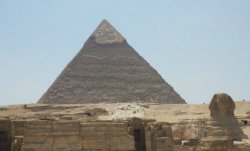
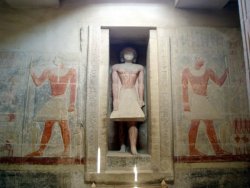
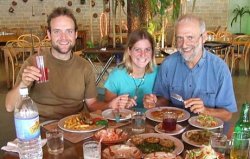
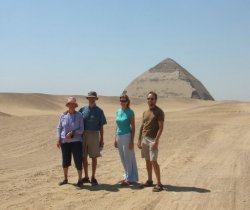
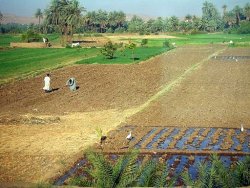
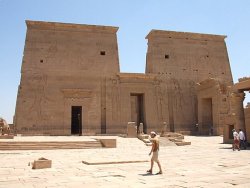
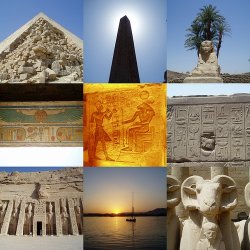
On our first day in Cairo we visited the Egyptian Museum for which a guide (human or written) is a must if you want to find your way around. Although the golden sarcophagi, and death mask of Tutankhamun were amazing, and the array of jewellery and other goods to accompany the pharaoh into the afterlife, odd things stick in the mind, such as the four canopic jars, and the miniature coffins that had been inside (containing lungs, liver, stomach, intestines). After lunch, we visited the Pyramids and Sphinx at Giza. It's hard to say what impresses most, the size (The Great Pyramid of Khufu/Cheops is the largest, nearly 140m high and made of about 2.3 million limestone blocks, weighing on average about 2.5 tonnes each) or the descent inside, down steep passageways to chambers with high stepped roofs. Next day we travelled outside Cairo to Dahshur to see the Bent and Red Pyramids built by Pharaoh Sneferu (father of Khufu). The former was the first attempt at a smooth-sided pyramid, but the initial angle chosen led to stress so that it had to be reduced, thus causing a bent appearance. Once down the passageway in the Red Pyramid we marvelled at the 12m-high corbelled ceilings (and wrinkled our noses at the ammonia smell from bats!). And so on to Saqqara, the vast cemetery of ancient Memphis. This is dominated by the Step Pyramid, the world's oldest pyramid built about 2650 BCE for the Pharaoh Zoser by Imhotep, his chief architect (later deified). Having wandered through the hypostyle hall and courtyards we went northeast into the pyramid of Teti, (the first Pharaoh of the 6th dynasty) containing his basalt sarcophagus (the first instance with inscriptions on it). Nearby,we went into the tomb of Mereruka, his highest official. This is the largest Old Kingdom courtier's tomb and contains a life-size statue of Mereruka appearing to walk out of the wall to receive offerings brought to him. All this was very classy stuff, but we were brought back to present-day Egypt with a bump when our attention was drawn by yells as a local man was horsewhipped by his fellow men, until dragged away with bleeding face. Wonder what he'd done? We recovered over an Egyptian meal, including stuffed pigeon, felafel, fuul, shammy (pita-like bread). That evening we boarded the night sleeper train to Aswan, waking in the morning to see scenes that could have come from the Bible. People riding donkeys, irrigating the fields alongside the Nile, tilling with simple tools and cattle grazing with their accompanying white egrets. Soon enough we were in Aswan and in the charge of a new (and our favourite) guide, Esmail. With a 2-year Master's in Egyptology following a 4-year degree in tourism, he was keen to interpret hieroglyphs and overcome our confusion over Pharaohs and Gods, as well as explaining the history of the places visited with him. First we took a boat-ride to the Isis temple complex in its attractive setting on Agilikia Island. This was originally located on Philae Island, and is one of the many temples moved and reconstructed when the Aswan High Dam was under construction. These are modern ruins compared to what we had seen earlier, dating from around 3rd century BCE and added to under Roman rule until the 3rd century AD, though Isis was still being worshipped at Philae as late as AD 550.
To more modern times - we went to the High Dam with Lake Nasser behind, the world's largest artificial lake. Built with Russian help (1960-1971) after the Suez Canal fiasco of 1956, the dam has provided enormous agricultural and electricity benefits but at considerable cost. The water table has been raised across North Africa, to a detectable level, as far away as Algeria. Of the 35,000 workers involved in the construction, about 450 lost their lives. Some 50,000 people (Nubians) had to be relocated because their homes were to be flooded along with most of the monumental relics of the ancient Nubian civilisations. The loss of the fertility brought by annual floods has increased fertilizer use and hence the salinity of surface water. The dam is 3.6 km long and 111m high and increased Egypt's agricultural acreage by 30% but the bilharzia parasite is now a problem because of the permanently full ditches. The dam is remarkably unimpressive to look at.
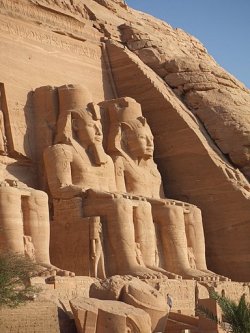
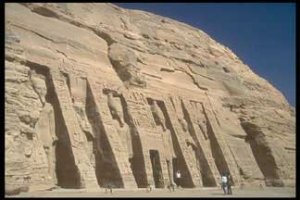
For security reasons our van had to travel to Abu Simbel in a convoy along with other tourist buses. This meant we had to rise at the unconscionably early hour of 0300 and then wait for all the other travellers to turn up. To our minds this created an obvious target for terrorists, but we survived the 3-hour journey across the desert, accompanied by an armed soldier. By 0730 we were looking up at the Great Temple of Rameses II with its giant sentinels gazing out over Lake Nasser and the desert beyond. Ramses II was Pharaoh during the 19th dynasty, ruling from 1279-1213 BCE and one of the great military leaders, waging war to reclaim Egypt's empire abroad. His temple is decorated inside with various reliefs depicting his success in battle. The smaller temple at Abu Simbel, the Temple of Hathor, is dedicated to Queen Nefertari, Ramses' beloved wife. The whole temple had to be cut out of the hillside in chunks and rebuilt on an artificial hill above the rising waters.
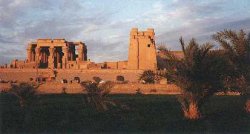
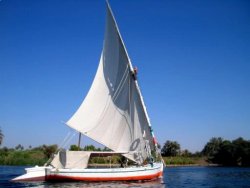
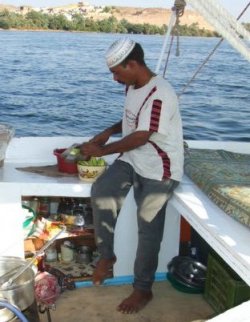
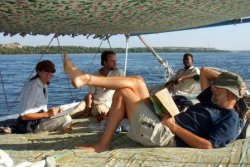
Returning to Aswan we boarded our felucca. (As an aside, just before leaving Ismailia we met a couple who had just returned from their inland trip - their felucca was a disaster: the boat had overturned, casting all occupants into the Nile - no lives were lost although valuable possessions were). The felucca is a small traditional-style sailing boat with no engine (and no bathroom facilities!) and provided us with a delightful interlude. Captain Nasser (ably assisted by Mohammed) was skilled not only at the helm but also in the "kitchen" supplying us with freshly cooked tasty meals. We sailed peacefully down the Nile, mooring overnight at the bank. Would that we had the equipment to record the sounds - camels groaning with protest as their owners washed them in the river, donkeys braying, various river birds calling. After a wonderful night's sleep on deck, broken only by the muezzin's early morning call, we ate freshly boiled eggs, cheese, bread, jam and arrived early for the next temple, of Kom Ombo. Unusually, this was a dual temple- to Haroeris or Horus the Elder, and Sobek, the local crocodile god.
And so, on to Luxor and our very comfortable hotel sporting, inter alia, a
swimming pool floating on the Nile. After sampling this and watching sunset
over the Nile we took to our beds to be ready for the early morning call. We
were up at 0500 to fully experience the buffet breakfast including 4 types
of yoghurt, and omelettes and pancakes made to order. Luxor, inhabited for
at least 6000 years, is actually three separate areas. The town itself, the
village of Karnak a couple of km to the northeast, the monuments and
necropolis of ancient Thebes on the west bank of the Nile. Thebes'
importance grew under Montuhotep II (2055-2004 BCE) of the 11th dynasty who
moved the capital of Egypt here. Its importance peaked in the New Kingdom
1550-1069 BCE when most of its great monuments were constructed. Our visit
there was to the Valley of the Kings, part of the necropolis of ancient
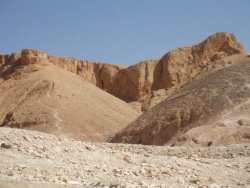
Thebes. The escarpment itself is quite stunning and few of the 60-odd tombs
which have been discovered are evident.
Our ticket enabled us to visit just
3 tombs, and our choice was further limited by which tombs were actually
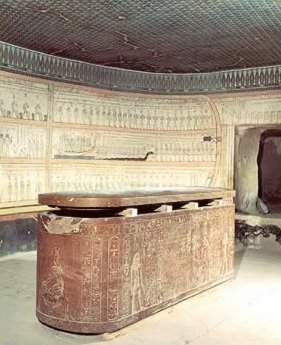
open. Of those we entered, that of Tuthmoses III (1479-1425 BCE) was most
memorable. Passing down long corridors we came to the highly decorated
antechamber, then further in, the burial chamber itself in the shape of a
cartouche and containing the black granite sarcophagus inscribed inside with
hieroglyphics.
Hatshepsut was one of the very small number of female Pharaohs. She ruled from 1473-1458 BCE, and the temple that she created remains splendid in spite of the vandalism of successors. Bypassing the massive, but ruined Ramesseum, we went onto Medinat Habu, a magnificent temple complex, second only in size to that at Karnak.
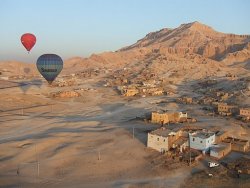
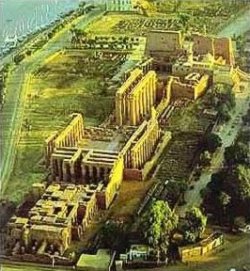
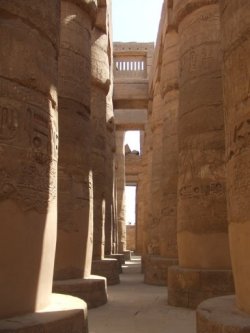
The next day, with Khepri, the God of the Rising Sun, and Ra, the supreme Sun God of Heliopolis in mind, we rose at 0445. Travelling via van, ferry over the river, another van to the launch site, we were airborne in our hot air balloon in time to see the sun's rise, its rays reflected in the Nile. As a first-time balloon flight for 3 of the 4 of us, it was excellent, giving a mellow view in the sun's early rays of all the areas of tombs and temples we had visited together with the workmen's village, the tombs of the nobles, with glimpses of daily life of the current living population. Wonderful! All too soon we were down with a bump, and after some celebratory dancing and drumming (and presentation of T-shirts) we were able to throw down a quick breakfast before going to Karnak. This was the most important place of worship in all Egypt during the height of Theban power and used over a period of 1500 years. Today you can still see the vast complex of pylons, obelisks, chapels, sanctuaries, and pillared halls which comprised the Amun temple enclosure, and hear echoes of its former glory. Remember Lara Croft in Tomb Raider? Well, the real Amun temple is more impressive! Our final historic site was that of the Luxor temple, modern compared to Karnak, having been largely built by the New Kingdom Pharaoh Amenhotep III (1390-1352 BCE). We still had time for shopping and collapsed into the night train for Cairo with bags stuffed with decorated papyrus and Bedouin crafts.
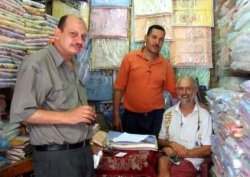
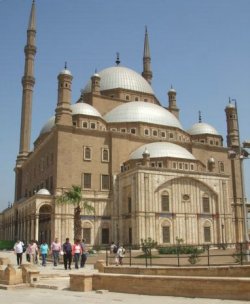
Arriving back in the big city we were whisked off to the Citadel, which Saladin began building in 1176 to fortify the city against the Crusaders and which was home to Egypt's rulers for a mere 700 years. This was modern stuff, and such a contrast to the pharaonic sites we had been visiting - the Mosque of An-Nasir Mohammed (1318), a remnant of the Mamluk empire, and the Mosque of Mohammed Ali (1830-48). In the great bazaar of Khan Al-Khalili, founded in the 14th century, we managed to find our way round the congested streets and alleyways to buy some locally made cotton sheets. Earlier attempts had resulted in finding "made in China" so we were pleased to get the genuine article, well we think so anyway they cost enough! We were so charmingly relieved of our money over cups of tea, that it was a worthwhile experience. And that was about it for our inland trip, our time was up, and it was not enough, but at the same time we couldn't take any more! After our return to Avalon in Ismailia we spent a few days provisioning, cleaning and packing away our souvenirs. Soon enough the day came to motor up the second half of the Suez Canal and wave goodbye to Egypt. Egypt's past glories fascinate and intrigue, but modern life, with its press of people, many demanding attention, is tiring. Direct demands for baksheesh that we had feared were little in evidence, but nearly every purchase had to be bargained for and every service tipped, a way of life for locals but sometimes exasperating for us. We were glad we had "done" it, but not sorry to leave.