South America (part seven)
Equadorian Exit
Drama in Puerto Lucia Yacht Club
We had one last set of traumas at the Puerto Lucia Yacht Club in Ecuador, so that "Avalon" only got into the water again at the third attempt. At the first attempt when the props were removed the anti-fouling paint came away bringing the undercoats with it: the bare steel was quickly repainted. The next day to avoid taking the new paint off, the slings of the travel-lift were repositioned with one under the bow, the other under the keel. As the travel-lift moved, the keel sling slipped and Avalon crashed onto the hard. The drop was only about a foot, the impact being taken equally on the keel and on the rudder and skeg. The shock wave up the mast sent the navigation lights, VHF antenna and windex tumbling to the ground. The rudder had been driven up and bent the steering quadrant. However, 10 days later the quadrant had been pressed straight and replaced, we had new parts fitted on the mast and we had not had to pay anything. Also on the plus side, during that period, we got to know Erwin, Doris and 3-year old son Alexander on "Moonwalker" on the hard next to us, enjoyed attending the 60th Birthday Party of Malcolm (and Jackie of "Aeolus XC"), Rosie got involved with a group of ladies making dresses and now has a pattern, 3 lengths of material bought locally, and one cut ready for sewing by hand (!), also we had one of our best taste experiences in Ecuador when we were treated to hot cinnamon rolls made by Annie (and Will of "Como No") our neighbour, when we were finally back in the water.
Equador to the Enchanted Islands
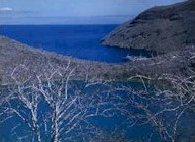
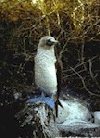
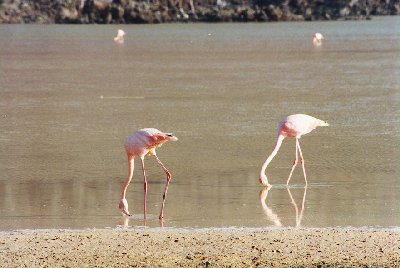
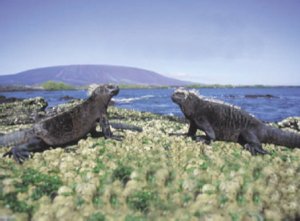
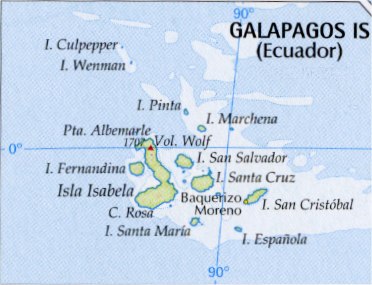
Ed: The Galapagos Islands consist of 6 main islands, 12 smaller islands and over 40 very small islets, lying about 700 miles west of Equador. The islands are made of volcanic lava, and are situated on the equator. (Click here for a map) Discovered in 1535 by Thomas de Berlanga (the Spanish bishop of Panama), the Galapagos Islands have always been totally isolated from the mainland, and the birds, reptiles, insects and plants which landed on their shores evolved over the centuries to create the unique wildlife that inhabits the islands today. Since the Islands were so isolated, the wildlife had no contact with humans and as a result has little fear. In 1835 Charles Darwin arrived on the islands, at the end of his journey on HMS Beagle (1831-1836). The scientific observations that he made during his stay on the islands formed the basis of his essay "The Origin of Species by Means of Natural Selection", published in 1859. The Spanish pirate Diego de Rivadeneira named the islands "Las Islas Encantadas (The Enchanted Islands). Land and marine iguanas bask in the tropical sun, 11 species of the giant tortoise which gave the island their name (galapago means tortoise in Spanish), scarlet birds, curious sea lions wanting to play, 13 species of finches (the famous Darwin finches), moonscapes and volcanic peaks, red sandy beaches, pink flamingoes, the largest breeding-colony of albatrosses in the world, penguins and blue-footed boobies performing their "sky pointing" dance.
Our five and a half day journey to the Galapagos Islands was enlivened by having to avoid fishing boats and nets, the worst incident being at night when a small panga with 3 fishermen gesticulating wildly bumped into us. We decided they were associated with a larger vessel some way off which had large nets and were trying to warn us off: anyway we steered well clear.
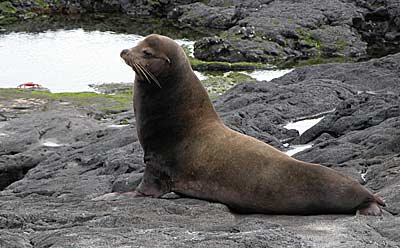
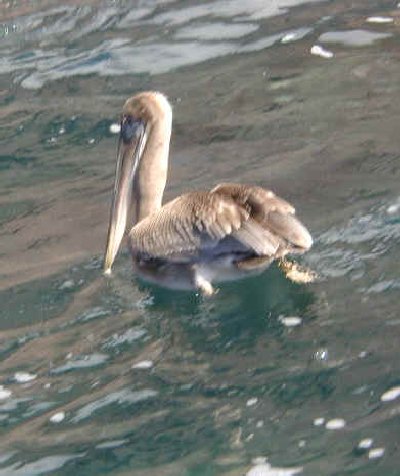
The Galapagos have, for us, more than lived up to their other name - "The Enchanted Islands". We have never been closer to wild animals and birds and in such profusion too. Our favourites are the marine iguanas and sea lions. The latter are very curious and playful, often heading straight for the dinghy once they spot you in it, then leaping out of the water and diving under the dinghy. The incident when Rosie stood in the sea and a young sea lion swam straight at her and bit her on the knee (no blood!) has been classed as an invitation to come and play!! We have been to 2 islands- San Cristobal and Isabela, and have seen far more marine iguanas on the latter. They like bodily contact and our record sighting was a pile of around 50 smaller ones. Their camouflage amongst the black lava rocks is so good that we have only become aware of some as they blew salt out of their nostrils before moving away. Usually seen basking motionless in the sun their turn of speed to escape on land, and their graceful swimming in the sea, is a surprise. Our anchorage at Villamil is a pretty one in a sheltered lagoon where we have seen the small (30cm tall) Galapagos penguins sitting on the rocks and swimming near the boat, blue-footed boobies and pelicans diving, and rays gliding past.
(Note:-Most experienced pilots just will not go in or out of Villamil in the dark so it must be a bit tricky.)
The long dinghy ride to shore has been hair-raising at times of low tide in the dark - with reefs and lines to fishing boats to be avoided. Our travels ashore have included a truck/horse-riding expedition to the Sierra Negra volcano (at 11km diameter the 2nd largest in the world) and more recent volcanic eruptions (steaming in parts), and a 20km walk to the "Wall of Tears" - a massive wall built of about a million lava blocks by prisoners.
(Note: The Wall of Tears is one of Isabela's most famous (or infamous) sites. It was built by the 300 prisoners of the penal colony which was established on Isabela in 1946, by the President of Equador, Velasco Ibarra. The chief of the penal colony dreamt up the wall as a way of keeping the prisoners occupied and subjugated. It is a dry stone wall 190 meters long, 9 meters high and 6 meters wide, made from stones - some enormous, some small - piled up in random fashion. Many of the prisoners died carrying out this useless task and the penal colony was closed in the 1950s).
These trips gave us the opportunity to see more of the wildlife - hundreds of butterflies and painted locusts, lava lizards, a lone Galapagos hawk soaring above the crater, a group of 40 flame-coloured flamingos on a lagoon, and curlews, American oystercatchers, lava gulls and ringed plovers along the beaches. Wonderful! However, the Marquesas, 3000 miles away, are beckoning - Jim dreamt in French the other night!! So we have already purchased a large stalk of green bananas, now suspended on deck. Today (Monday 13 May) after the supply plane has arrived, we aim to buy more fresh fruit and veg, as well as collecting our ship's papers from the Port Captain. Our plan is to leave tomorrow to sail through the Bolivar Channel between Isabela and Fernandina in the hope of seeing whales (maybe orcas and sperm whales), and then head west.
(NOTE:- Since we have not heard from Jim and Rosemary since 14th May, we assume that they are well into their voyage across the Pacific, and will not be in contact again until they reach the Marquesas hopefully in the middle of June. That is if they can find a way of communicating - we do not know if there will be Internet facilities on the Marquesas. I will let you know when I get news).

Click on the globe to view map which shows
the Pacific crossing from the Galapagos Islands
to the Marquesas - distance
very approximately 3,500 miles