Caribbean Idyll
Exploring the Caribbean - (part two)
Martinique, Dominica and Gaudeloupe
Click here for a map of the area. More detailed maps are available in the text. the text.
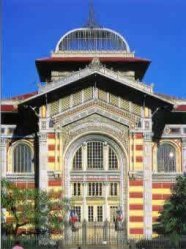
Ed: Rosemary - a librarian to the core - could not resist this picture of the Bibliotheque Schoelcher, on Martinique. Splendid, eh?
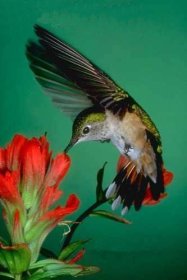
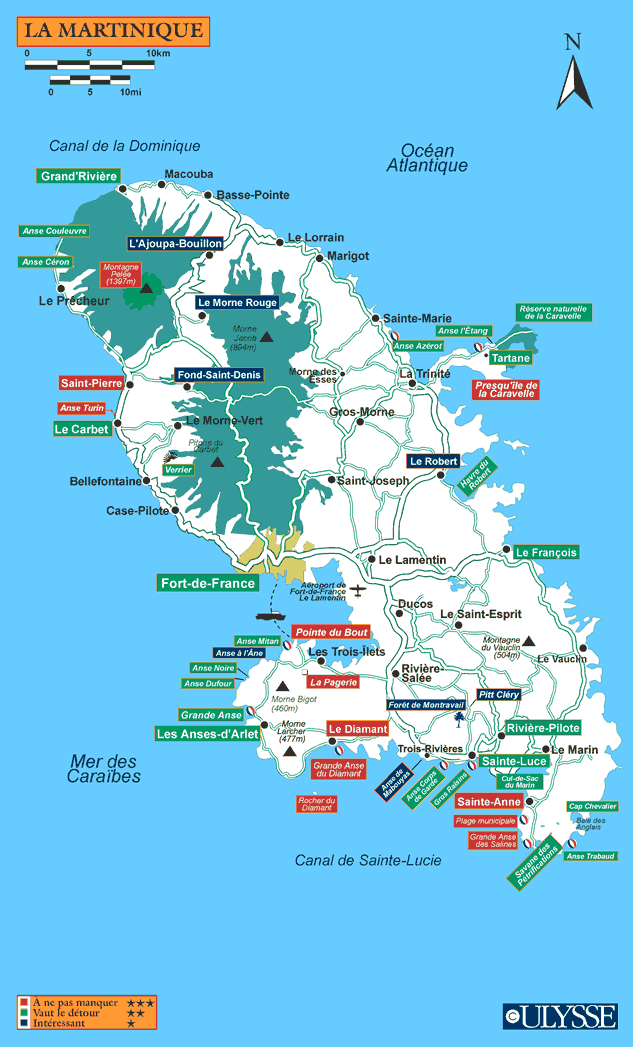
Our stay in Martinique (Click here for a map ) was almost like being in France with baguettes, pain au chocolat, avoiding lobster pots along the coast and having to speak French. We anchored in several places and were able to swim and snorkel in lovely clear water. Our day in the capital, Fort de France, was very peaceful as it was Ascension Day and everything was closed but the churches! The highlight of our visit to the country was our stop in St Pierre, where we were anchored in the bay at the foot of Mount Pelee. The volcano there erupted in 1902 devastating the town and killing nearly 30,000 inhabitants: now only a few walls remain of the original buildings. We took a bus as near as we could to the Canal de Beauregard, which had been constructed by slaves in 1760 to supply water to the rum distilleries. The walk along this was great - not only did we see beautiful mountain scenery, but also lots of flowering plants, hummingbirds and fallen mangoes (we collected, and eventually ate, over 40 mangoes!).
It rained mightily (but we had our umbrellas with us) and we learned later that this was the first rain in Martinique for 2 and a half months - the land needed it, and the land crabs certainly seemed to enjoy it, as they came out in their hundreds - everywhere we looked they were scuttling away from us into their holes. It was rather unnerving at times as there were so many the ground seemed to be moving. At the beginning of the canal we found a river pool so inviting that Jim had to strip off and plunge in.
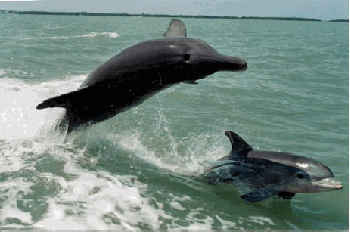
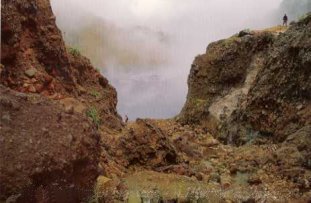
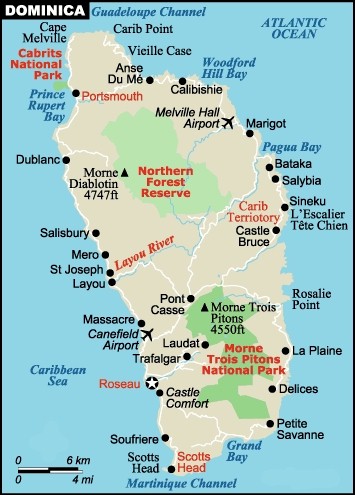
Dolphins leapt and twirled as we left for Dominica, (Click here for a map) the most southerly of the Leeward Islands, on May 27. We anchored near Roseau, the capital, and from there made a tour of the south part of the island by car, shared with an Australian couple. In this way we were able to visit several waterfalls, swimming under one in "The Emerald Pool", sulphur springs and lakes. We walked through lush tropical rainforest enjoying the sounds of hidden birds and frogs. Another day we took a guided hike through the "Valley of Desolation" to "The Boiling Lake".This was a 6-hour round trip which was pretty strenuous, but worth the effort to see the steaming sulphurous vents, bubbling black streams, and finally the lake in the crater of the volcano- just like suds whirling in a giant washing machine. Aching muscles were eased at the end of the descent in a cool pool, whence we swam up the narrow Titou Gorge (only about 8 feet wide in parts) to the first waterfall: this was magical, so peaceful with no-one else around. Next we moved further north and anchored in Prince Rupert Bay, near the town of Portsmouth. This was a calm anchorage that we enjoyed for several days, swimming round the boat or to shore as the fancy took us. We hired Martin, a very pleasant and knowledgeable guide, who rowed us up the Indian River one morning at 6.30: he was able to tell us the names of the crabs, birds, trees and flowers that we saw. We then went on to a walk through agricultural land where we saw, in addition to the familiar mango and banana trees, oranges, lemons, grapefruit, coffee (in flower and fruit), cocoa, papaya, nutmeg, cinnamon, wild ginger - what an abundance of fruits and flowers to taste and smell! We reached the Milton Falls where we swam in the pool below and gazed up through the forest to see a broad-winged hawk circling high above. We later saw an iguana by the road on our way to a forest trail where we marvelled at the vines, ferns, huge exposed root systems of trees, and were lucky to see a rare jaco parrot. At the end of our morning Martin presented us with a cornucopia of fruit and flowers that he had gathered on the way. Wonderful
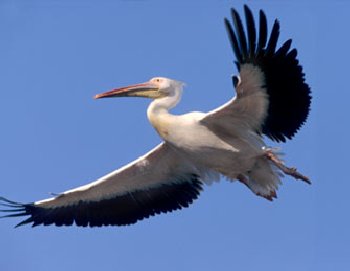
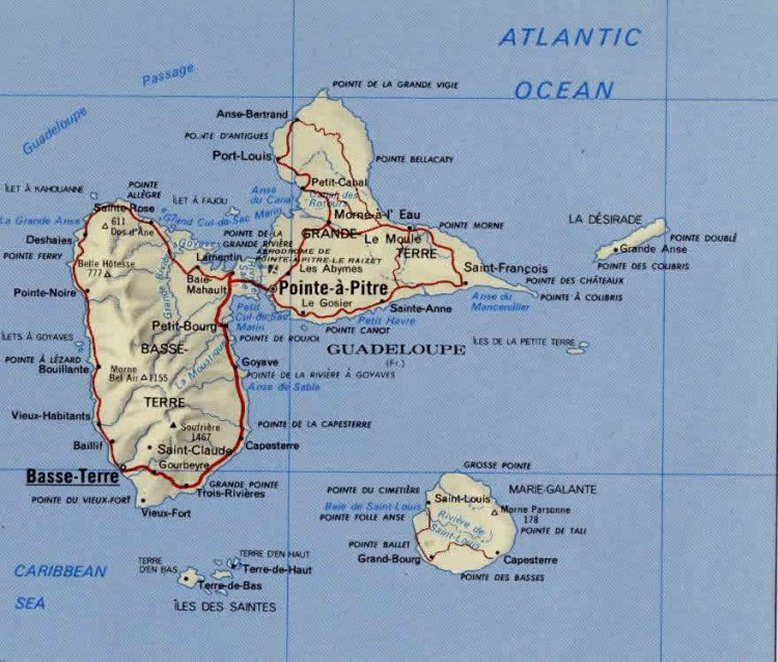
Our next anchorage was in The Saintes a small group of islands, just south of the mainland of Guadeloupe (Click here for a map). Although pretty, these seemed very barren and dry compared to Dominica. And we were back to speaking French again, and paying higher prices. However we also saw our first pelican this trip. After a few days we battled against the prevailing wind and current to reach the marina at Bas-du-Fort, near Pointe a Pitre. One reason for this was to attend to some of the increasing number of problems concerning the boat - in particular the broken bilge pump, and non-functioning fridge. We were hoping to hire a car, but due to a strike there is a shortage of petrol so we are not able to see the volcano and waterfalls which are supposed to rival those of Dominica. We walked into Pointe a Pitre, which is an interesting mix of old and new: from old wooden buildings with lacy ironwork to the well-known Macdonalds. By the time we got there on a Saturday lunchtime we had a hard job finding anything open: eventually we found a restaurant where we enjoyed salads of local crayfish and chicken, the cockroaches running around were not so welcome.
We have met some friendly Americans here, so have been socialising again, and hope to meet up again later with those who are heading south. From here we aim to go up the Riviere Salee which divides the island: this involves anchoring overnight in the river near the bridges which open briefly at 5a.m. to let river traffic through. We then head north towards St Martin. This brings you pretty much up to date. We have the fridge man coming tomorrow: what he has to say will determine when we leave.
Ed: Latest - We have heard that the fridge was fixed, but no word yet on when they are turning south towards Grenada, where they intend to moor the boat during July.